September 3, 2026
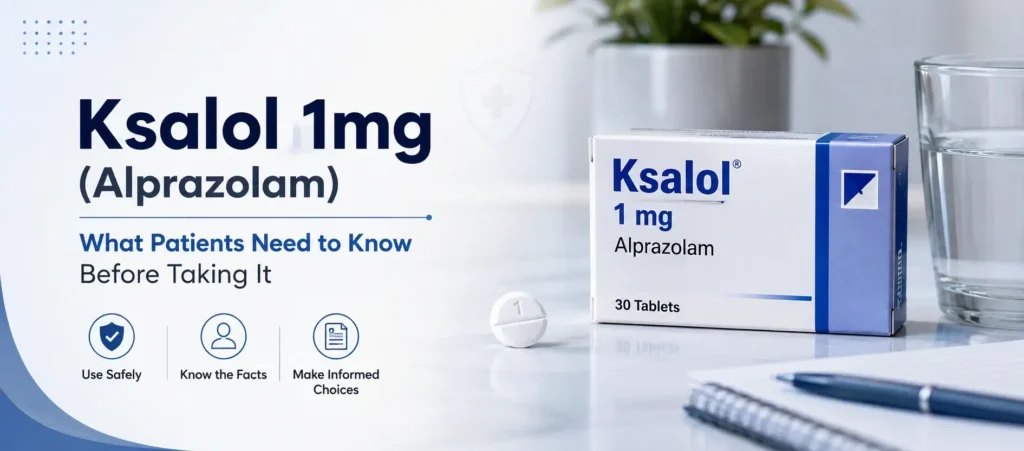
Ksalol 1mg (Alprazolam) — What Patients Need to Know Before Taking It
⚕️ Medical Disclaimer
This article is for informational and educational purposes only. It is intended for patients who have already been prescribed alprazolam by a licensed healthcare provider. This content does not constitute medical advice, diagnosis, or treatment. Never adjust your dose, stop taking, or start alprazolam without consulting your prescribing physician or licensed pharmacist. Abrupt discontinuation of benzodiazepines can be dangerous and potentially life-threatening. In a medical emergency, call 911 immediately.
For patients prescribed alprazolam to manage anxiety or panic disorder, understanding your medication is one of the most important steps toward using it safely. Ksalol 1mg contains alprazolam — a benzodiazepine with a well-established clinical profile and specific safety requirements every patient must know. This guide covers what alprazolam is, how it works, how to take it correctly, what to watch for, and what to absolutely avoid. It is written for patients already under the care of a licensed US healthcare provider.
💊 Quick Drug Facts — Ksalol 1mg
Active Ingredient: Alprazolam 1mg
Drug Class: Benzodiazepine
DEA Schedule: Schedule IV (CIV)
Onset: 15–30 Minutes
Rx Required: Yes — All US States
Indications: Anxiety Disorder, Panic Disorder
What Is Ksalol 1mg?
Ksalol 1mg is a prescription medication containing alprazolam 1mg as its active ingredient. Alprazolam belongs to the benzodiazepine class of drugs — a category of central nervous system depressants widely used in the management of anxiety disorders and panic disorder in the United States.
Alprazolam is one of the most prescribed psychiatric medications in the USA. It is marketed under several brand names — the most widely recognised being Xanax — and is also available in generic form.
In the United States, alprazolam is classified as a DEA Schedule IV controlled substance. This means it has an accepted medical use but carries a recognised potential for dependence, misuse, and abuse. It is available only with a valid prescription from a licensed US healthcare provider.
Definition: Ksalol 1mg is a benzodiazepine prescription medication containing alprazolam 1mg — indicated for the management of anxiety disorders and panic disorder in adults — classified as a DEA Schedule IV controlled substance and available exclusively by prescription in the United States.
How Does Ksalol 1mg Work?
Alprazolam works by enhancing the activity of gamma-aminobutyric acid (GABA) in the brain — the body’s primary inhibitory neurotransmitter. Here is how the mechanism works in plain terms:
- GABA is a naturally occurring chemical that reduces neuronal excitability throughout the nervous system
- Alprazolam binds to GABA-A receptors and enhances GABA’s inhibitory effect — producing a calming, sedative response
- This reduces the excessive neuronal firing associated with anxiety, panic attacks, and related conditions
- The result is a reduction in anxiety symptoms, muscle tension, and physiological arousal — typically within 15 to 30 minutes of oral ingestion
- At the 1mg dose, alprazolam produces pronounced anxiolytic (anti-anxiety) and sedative effects
Unlike some medications that take weeks to build therapeutic effect, alprazolam acts relatively quickly — which is why it is used for both generalised anxiety management and acute panic episodes.
What Is Ksalol 1mg Prescribed For?
Alprazolam 1mg is FDA-approved for two primary indications in adults:
1. Generalised Anxiety Disorder (GAD)
Characterised by persistent, excessive worry about multiple areas of life — work, health, finances — that is difficult to control and significantly impairs daily functioning.
2. Panic Disorder
Defined by recurrent, unexpected panic attacks — sudden surges of intense fear accompanied by physical symptoms including racing heart, shortness of breath, dizziness, and chest tightness — with or without agoraphobia.
⏱ Duration Note
Alprazolam is generally indicated for short-to-medium term management. Long-term use requires careful, ongoing physician supervision due to the risks of tolerance, dependence, and withdrawal. Always follow your physician’s prescribed duration exactly.
Ksalol 1mg Dosage — Standard Guidelines
Dosage is always determined by your prescribing physician. The following represents standard alprazolam prescribing guidelines — always follow your specific prescription instructions exactly.
Standard Adult Dosing — Anxiety Disorder
| Dose Timing | Starting Dose | Typical Range | Max Daily Dose |
|---|---|---|---|
| 3x daily (TID) | 0.25mg – 0.5mg | 0.5mg – 4mg/day | 4mg/day |
Standard Adult Dosing — Panic Disorder
| Dose Timing | Starting Dose | Typical Range | Max Daily Dose |
|---|---|---|---|
| 3x daily (TID) | 0.5mg | 1mg – 10mg/day | 10mg/day |
How to Take Ksalol 1mg Correctly
- Take exactly as prescribed — do not adjust your dose independently
- Can be taken with or without food — food may reduce stomach discomfort in some patients
- Swallow the tablet whole with water — do not crush, chew, or split unless your physician instructs
- Take doses at evenly spaced intervals throughout the day as directed
- Never double-dose if you miss a scheduled dose — skip it and resume your regular schedule
- Never stop taking alprazolam abruptly — see the withdrawal section below for why this is dangerous
Who Should and Should Not Take Ksalol 1mg
Appropriate Candidates
Ksalol 1mg may be appropriate for adults who:
- Have been diagnosed with anxiety disorder or panic disorder by a licensed physician
- Have undergone a full medical evaluation confirming no contraindicated conditions
- Are under active, ongoing medical supervision throughout the treatment course
- Understand and accept the risks associated with benzodiazepine therapy including dependency potential
Contraindications — Who Should Not Take Ksalol 1mg
- Patients with a known hypersensitivity to alprazolam or any benzodiazepine
- Patients with acute narrow-angle glaucoma
- Pregnant or breastfeeding women — alprazolam is associated with fetal harm and neonatal withdrawal syndrome
- Patients with a history of substance use disorder — dependency risk is significantly elevated
- Patients currently taking strong CYP3A inhibitors (ketoconazole, itraconazole)
- Individuals under 18 years of age — not approved for paediatric use
- Patients with severe hepatic impairment
FDA Black Box Warning — What Every Patient Must Know
The FDA has issued a Black Box Warning — its most serious safety warning — on all benzodiazepine medications including alprazolam. Every patient prescribed Ksalol 1mg must understand these three critical warnings:
⚠️ Warning 1 — Risks from Concomitant Use with Opioids
Combining benzodiazepines with opioid medications can cause profound sedation, respiratory depression, coma, and death. If you are prescribed any opioid pain medication alongside alprazolam, discuss this risk explicitly with your physician. This combination requires very careful medical management.
⚠️ Warning 2 — Abuse, Misuse, and Addiction
Alprazolam has a recognised potential for abuse, misuse, and addiction — which can lead to overdose and death. Taking alprazolam in higher doses than prescribed, more frequently than prescribed, or in ways not intended by your physician significantly elevates this risk.
⚠️ Warning 3 — Physical Dependence and Withdrawal
Physical dependence can develop with alprazolam — even when taken as prescribed. Withdrawal reactions can be severe and potentially life-threatening — including seizures. Never stop taking alprazolam abruptly. Any discontinuation must be done under physician supervision with a carefully managed tapering schedule.
Ksalol 1mg Side Effects — What Patients Need to Monitor
Like all medications, alprazolam carries a risk of side effects. Most are manageable — but some require immediate medical attention.
|
Common Side Effects
|
Serious — Seek Medical Attention
|
Drug Interactions — What to Avoid While Taking Ksalol 1mg
The following substances and medications interact dangerously with alprazolam and must be avoided unless specifically directed by your physician:
- Alcohol — Never combine with alprazolam. The combination produces dangerous CNS and respiratory depression that can be fatal.
- Opioid pain medications — Covered by FDA Black Box Warning. Life-threatening respiratory depression risk.
- Other benzodiazepines or CNS depressants — Additive sedation and respiratory risk
- Strong CYP3A4 inhibitors — Ketoconazole, itraconazole, certain HIV medications — dramatically increase alprazolam blood concentrations
- CYP3A4 inducers — Rifampin, certain anticonvulsants — significantly reduce alprazolam effectiveness
- Antihistamines and sleep aids — Additive sedation effects
- Grapefruit juice — Inhibits CYP3A4 metabolism and can raise alprazolam levels
Always provide your prescribing physician and pharmacist with a complete list of all medications, supplements, vitamins, and herbal products you are taking before starting alprazolam.
Dependence, Withdrawal, and Tapering — Critical Safety Information
Alprazolam carries a significant risk of physical dependence — even when taken exactly as prescribed at therapeutic doses.
Signs of Physical Dependence
- Increased anxiety between doses (interdose withdrawal)
- Feeling unable to function normally without the medication
- Needing higher doses to achieve the same effect (tolerance)
- Physical discomfort when doses are delayed or missed
Withdrawal Symptoms — Why Abrupt Stopping Is Dangerous
Abrupt discontinuation of alprazolam — particularly after extended use — can trigger severe, potentially life-threatening withdrawal symptoms including:
- Seizures
- Delirium
- Severe rebound anxiety and panic
- Insomnia and tremors
- Sweating and elevated heart rate
- Hallucinations
This is not a medication you can safely stop on your own. Any decision to discontinue alprazolam must be made with your physician, who will design a structured tapering schedule — typically reducing the daily dose by no more than 0.5mg every three days, though slower tapers are often required for patients on higher doses or longer-term therapy.
Ksalol 1mg vs. Similar Medications — Educational Comparison
Your physician selected your specific medication based on your diagnosis, medical history, and clinical profile. Do not switch medications without medical consultation. This comparison is for educational context only.
| Medication | Active Ingredient | Class | Onset | Primary Use |
|---|---|---|---|---|
| Ksalol 1mg | Alprazolam 1mg | Benzodiazepine | 15–30 min | Anxiety, Panic Disorder |
| Xanax | Alprazolam | Benzodiazepine | 15–30 min | Anxiety, Panic Disorder |
| Valium | Diazepam | Benzodiazepine | 30–60 min | Anxiety, Muscle Spasm |
| Klonopin | Clonazepam | Benzodiazepine | 20–60 min | Panic Disorder, Seizures |
| Ativan | Lorazepam | Benzodiazepine | 15–30 min | Anxiety, Pre-procedure |
| Buspar | Buspirone | Azapirone | 2–4 weeks | GAD (non-addictive) |
📍 State-Specific Note: Prescription requirements for Schedule IV controlled substances including alprazolam vary by state across the USA. Telehealth prescribing rules for benzodiazepines have been subject to evolving federal and state regulations. Patients in all 50 states should confirm their prescription is issued by a licensed healthcare provider authorised to prescribe Schedule IV substances in their state of residence. Contact primereliefrx.com for state-specific guidance.
How PrimeReliefRx Can Help
primereliefrx.com is a US-based licensed pharmacy resource providing patient education, prescription support, and pharmacist-accessible information for patients managing anxiety-related conditions — including those prescribed alprazolam.
If you have questions about your medication — dosage, interactions, tapering concerns, or refill process — our licensed pharmacy team is available to provide accurate, professionally verified guidance.
The Bottom Line on Ksalol 1mg
Ksalol 1mg — containing alprazolam 1mg — is a clinically established prescription medication for anxiety disorder and panic disorder. Used correctly, under active physician supervision, with full awareness of its risks and requirements, it can provide meaningful relief for patients managing these conditions.
The most important things every patient must understand: alprazolam carries real dependency risk, must never be stopped abruptly, must never be combined with alcohol or opioids, and requires ongoing medical supervision throughout the treatment course.
Have questions about your alprazolam prescription? Our licensed pharmacy team at primereliefrx.com is here to help.
Frequently Asked Questions
What is Ksalol 1mg used for?
Ksalol 1mg contains alprazolam — a prescription benzodiazepine used for the management of generalised anxiety disorder (GAD) and panic disorder in adults. It reduces excessive anxiety symptoms and panic attack frequency. It is a controlled substance available only with a valid prescription from a licensed US healthcare provider.
How long does Ksalol 1mg take to work?
Alprazolam typically begins producing anxiolytic effects within 15 to 30 minutes of ingestion. Peak plasma concentrations are reached within 1 to 2 hours. The duration of effect is typically 4 to 6 hours — which is why it is commonly prescribed three times daily for anxiety management.
Is Ksalol 1mg the same as Xanax?
Ksalol 1mg and Xanax share the same active ingredient — alprazolam — and work through the same mechanism. They are therapeutically equivalent in terms of active ingredient. Your physician or pharmacist can clarify any differences relevant to your specific prescription.
Can Ksalol 1mg cause dependency?
Yes. As an FDA Black Box Warning clearly states, alprazolam carries a significant risk of physical dependence — even when taken as prescribed at therapeutic doses. This is why it requires active physician supervision, adherence to prescribed dosing, and a medically managed tapering schedule if discontinuation is required.
Can I drink alcohol while taking Ksalol 1mg?
No. Alcohol must be completely avoided while taking alprazolam. Combining alcohol with any benzodiazepine produces dangerous CNS and respiratory depression that can be life-threatening. This is a hard contraindication — not a caution.
What happens if I stop taking Ksalol 1mg suddenly?
Abruptly stopping alprazolam — particularly after extended use — can trigger severe withdrawal symptoms including seizures, delirium, severe rebound anxiety, and other potentially life-threatening reactions. Never stop taking alprazolam without physician guidance. A structured tapering schedule is required.
Can Ksalol 1mg be taken long-term?
Alprazolam is generally indicated for short-to-medium term management. Long-term use requires careful ongoing physician supervision due to the risks of tolerance, dependence, and cognitive effects. Your physician will assess whether continued prescription is clinically appropriate based on your response and risk profile.
Can Ksalol 1mg be prescribed via telehealth in the USA?
Telehealth prescribing of Schedule IV controlled substances including alprazolam is subject to state-specific and federal regulations that have been evolving since 2020. Rules vary significantly by state. Patients should confirm their telehealth provider is authorised to prescribe Schedule IV substances in their state of residence before proceeding.
Switching takes about two minutes.
Staying is what takes years.
Start a transfer now — we’ll confirm your price and delivery date today.
Start my transfer